2026-09-12
A Facelift Is Not Just Pulling the Skin — The Core Principles of Deep Plane Facelift | Tailor Plastic Surgery
Tailor Plastic Surgery explains why a facelift is not merely pulling skin, highlighting the principles of deep plane facelifts, SMAS repositioning, and retaining ligament release.
Hello, this is Dr. Woo-hyun Tak from Tailor Plastic Surgery.
During facelift consultations, there is one question I hear most often.
"Is a facelift a surgery that simply pulls the skin upward?"
In the past, many people thought of a facelift merely as a procedure to pull lax skin tight.
However, actual facial aging does not occur only within a single layer of skin.
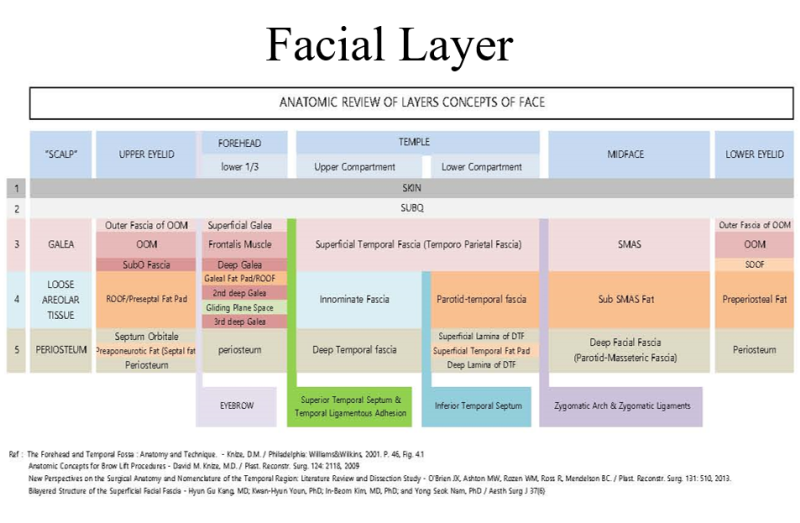
Multiple structures—including the subcutaneous fat, SMAS, retaining ligaments, fascia, muscles, and even neck tissues—undergo changes together, manifesting as sagging cheeks, a collapsing jawline, and neck wrinkles.
Therefore, modern facelift surgery focuses less on forcefully pulling the skin tight, and more on identifying how deep facial tissues have sagged and shifted, followed by adjusting the necessary underlying structures in harmony.
In this post, I will explain what the widely discussed **Deep Plane Facelift** is and why the SMAS layer is so critical.
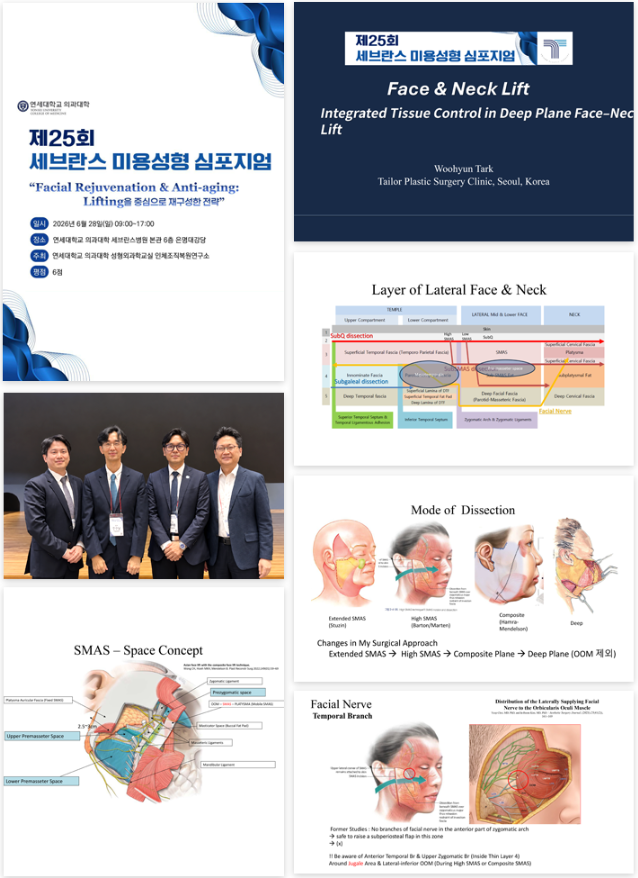
This content is based on my presentation at the Face & Neck Lift session during the 25th Severance Aesthetic Plastic Surgery Symposium in June 2026.
What is a Deep Plane Facelift?
As the name suggests, a deep plane facelift is a surgical approach where sagging tissues are dissected and repositioned within the deeper layers of the face.
What matters here is not merely the fact that surgery is performed "deeply."
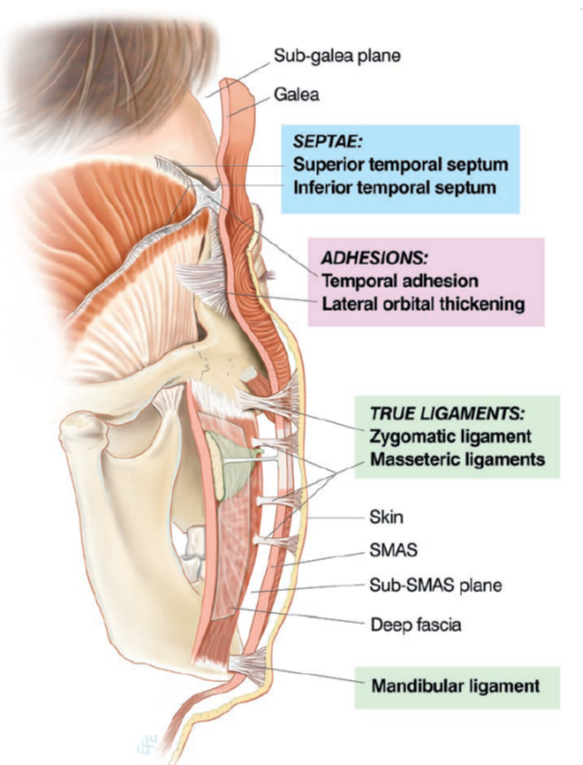
The face contains spaces where tissues move relatively freely, as well as firm **retaining ligaments** that anchor the tissues down.
With aging, when cheeks or the jawline sag, simply pulling forcefully from the outer surface often fails to move the tissues naturally.
The core principle of a deep plane facelift is to appropriately release these retaining ligaments, allowing the skin and deep tissues to shift together in a much more natural manner.
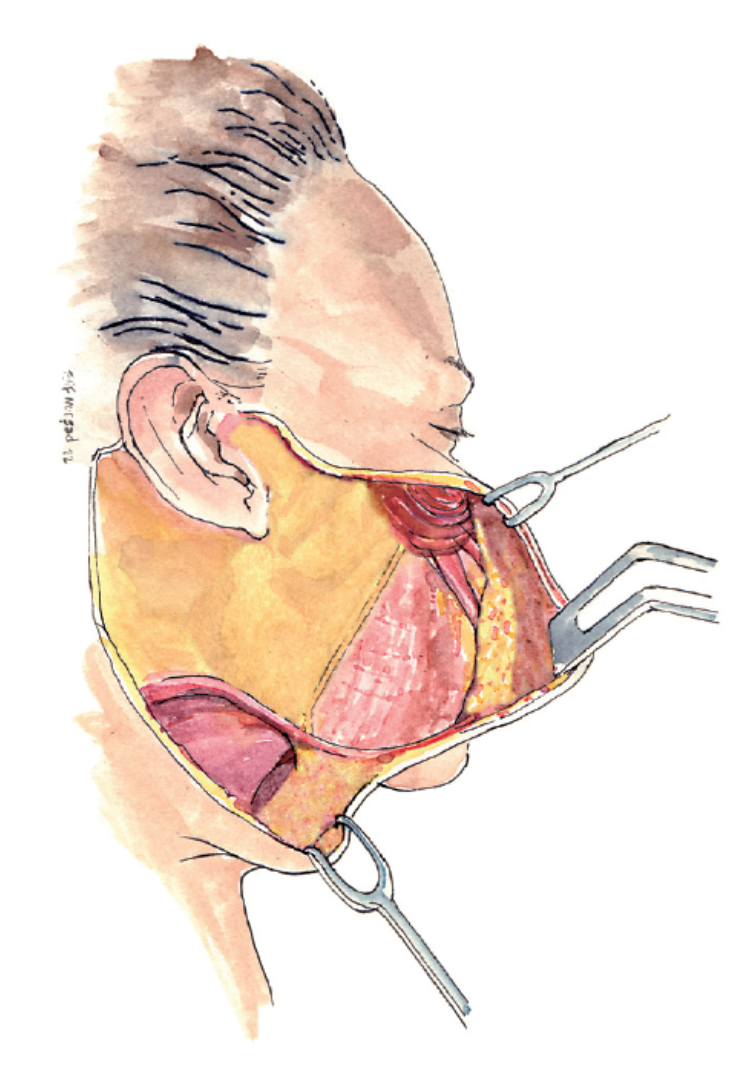
In a strict sense, this approach minimizes dissection between the skin and SMAS layer, directing the extensive dissection primarily underneath the SMAS layer. This preserves the structural integrity of the SMAS, speeds up recovery, and reduces complications.
Current surgical consensus recognizes that overly extensive subcutaneous skin dissection slows recovery without offering meaningful improvements to the lifting effect.
What is the SMAS?
Anyone who has researched facelifts has likely encountered the term SMAS.
The SMAS (Superficial Musculoaponeurotic System) is a fibromuscular layer situated beneath the skin, connecting with facial expression muscles and the platysma muscle of the neck.
Simply put, it can be thought of as a sturdy structural framework just below the skin that interconnects the soft tissues of the face.
In older techniques that pulled only the skin, excessive tension was often placed on the skin surface. In modern surgery, mobilizing the deeper SMAS along with the skin has become an essential concept.
Only by shifting the deep structures together, rather than tugging solely on the skin, can facial sagging be addressed on a foundational, anatomical level.
How Does a Deep Plane Facelift Differ from a Traditional SMAS Facelift?
There are various ways to manage the SMAS layer.
Techniques include plication (folding the SMAS), partial excision with suspension, or entering the deeper plane to mobilize the SMAS and skin together as a single composite unit.
The deep plane facelift falls into the latter category.
Its primary goal is to naturally reposition tissues—especially around the anterior cheeks and nasolabial folds—that cannot be adequately lifted simply by pulling the SMAS laterally from the side.
Category | Traditional SMAS Lift | Deep Plane Technique |
Dissection Plane | Above the SMAS | Below the SMAS |
Release of Retaining Ligaments | Minimal | Actively dissected and released |
Midface/Anterior Cheek Movement | Limited | More natural mobilization |
Extent of Skin Dissection | Extensive | Minimized |
Recovery | Relatively longer | Relatively fast |
However, it is difficult to conclude that one particular method is unconditionally superior.
The ideal approach varies according to the pattern of facial aging, skin thickness, fat distribution, facial bone structure, and whether previous surgeries have been performed.
Ultimately, the Key is Not "How Much You Pull"
During consultations, some patients request: "Please pull it as tight as possible."
However, in my view, the goal of a facelift is not to maximize tension.
Excessive tension can result in an unnatural, distorted appearance.
What truly matters is identifying where the tissues have sagged, releasing the necessary ligaments appropriately, and repositioning each structural component back into its natural location.
In other words, harmonizing and restoring structural balance to the face is far more important than merely making the skin taut.
In Part 2, I will discuss Integrated Tissue Control—a philosophy I emphasize—which details how we comprehensively evaluate and adjust not only the SMAS, but also the malar fat pads, buccal fat, submandibular glands, and temporal fascia.
https://youtu.be/f5Hue0fDIWw
Sincerely, Dr. Woo-hyun Tak, Tailor Plastic Surgery
Frequently Asked Questions
Is a facelift surgery that only pulls the skin?
No, a facelift is not just pulling the skin. Facial aging involves complex changes across multiple anatomical layers, including fat, SMAS, retaining ligaments, and muscles. Achieving a natural result requires addressing and repositioning these deeper tissues beneath the skin.
What is a deep plane facelift?
It is a surgical procedure that dissects underneath the SMAS—in the deep plane of the face—to reposition sagging tissues. By properly releasing the anchoring retaining ligaments, both skin and deep structures move together naturally, while minimizing skin dissection to support faster healing.
What is the SMAS layer in a facelift?
The SMAS (Superficial Musculoaponeurotic System) is a fibromuscular layer beneath the skin that connects to facial expression muscles and the platysma muscle in the neck. Working with this layer relieves surface tension on the skin and restores sagging facial architecture more effectively.
How does a deep plane facelift differ from a standard SMAS lift?
The primary difference lies in the plane of dissection and the release of retaining ligaments. While a standard lift often dissects widely above the SMAS layer, a deep plane lift minimizes skin elevation and dissects underneath the SMAS, releasing ligaments for a more natural repositioning of the midface and anterior cheeks.
Is it better to pull the face as tight as possible during a facelift?
No, pulling as tight as possible does not guarantee optimal outcomes. Excessive tension can create an unnatural, operated look. It is far more important to release retaining ligaments properly and reposition structural tissues in balanced harmony.