2026-09-22
Revision Facelift: How Does It Differ from the Primary Surgery? — Why Revision Is Far More Complex | Tailor Plastic Surgery
Tailor Plastic Surgery's Dr. Woo-hyun Tak explains why revision facelifts require advanced anatomical understanding, safe plane identification, and deep tissue repositioning over excessive tension.
Hello, this is Dr. Woo-hyun Tak from Tailor Plastic Surgery.
In the previous post, I discussed how a facelift is not merely about pulling the skin,
but about understanding the specific anatomical layers where facial aging has progressed and correcting them accordingly.
Extending that discussion, today I would like to talk about secondary facelifts (revision facelifts).
Some patients consider revision surgery because sagging has recurred over time after an initial facelift, or because the results of the primary procedure were unsatisfactory.
A revision facelift involves significantly more factors to consider than a primary surgery.
The integrated tissue control discussed previously must also be re-evaluated item by item during revision cases.
With growing interest in this field,
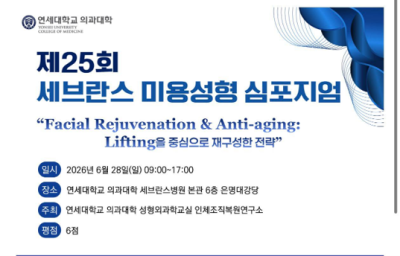
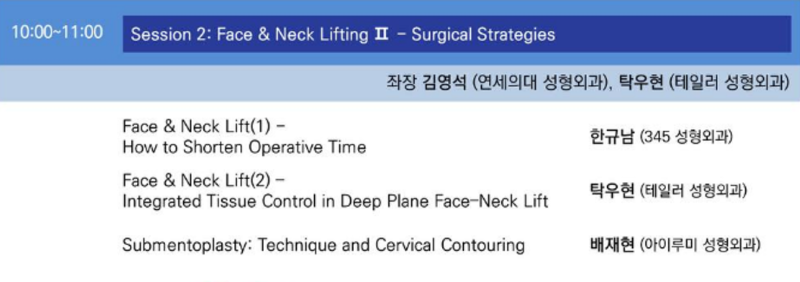
I was invited to the Yonsei University Severance Aesthetic Plastic Surgery Symposium this past June to deliver a lecture on facelifts and revision procedures, reviewing surgical footage to demonstrate integrated tissue control.
In this article, I will explain why revision surgery is sought and why it is inherently more complex than the primary procedure.
1. Why do patients consider revision surgery?
There are largely two main reasons patients seek a revision facelift.
The first is the natural progression of aging over time.
Undergoing a facelift does not stop the aging process altogether.
As years pass post-surgery, skin and soft tissue elasticity decline again, and gradual sagging may reappear in the midface, jawline, and neck.
In such instances, revision surgery is not a failure of the primary procedure, but rather a secondary correction addressing the natural course of aging.
The second reason is an unsatisfactory outcome from the primary surgery.
Common scenarios include:
Insufficient improvement in the jawline or neck contour
Persistent sagging in the cheeks or around the mouth
Skin that looks tight, but deep facial tissue sagging that was insufficiently addressed
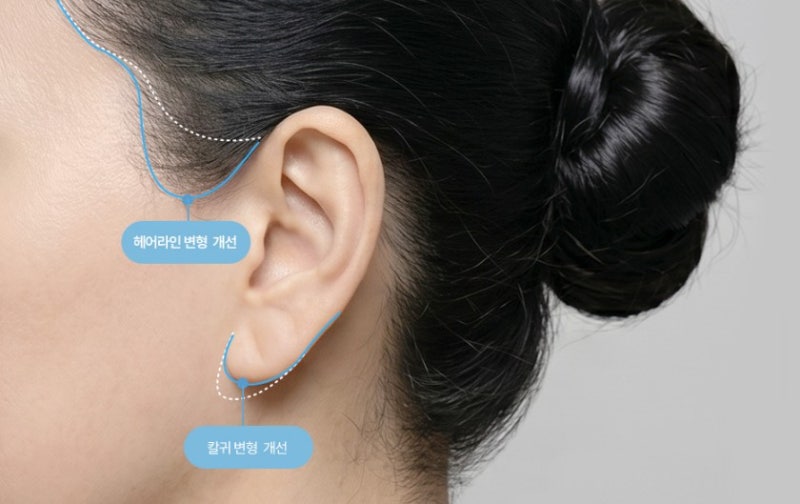
Widened or poorly positioned scars around the ears
Distorted ear morphology or an elongated, pulled earlobe appearance (pixie ear deformity)
Residual asymmetry or unnatural tension lines
In these situations, the goal is not simply to pull tighter. It is essential to first analyze what was performed in the primary surgery and what specific anatomical concerns remain.
2. Why is revision surgery more difficult than primary surgery?
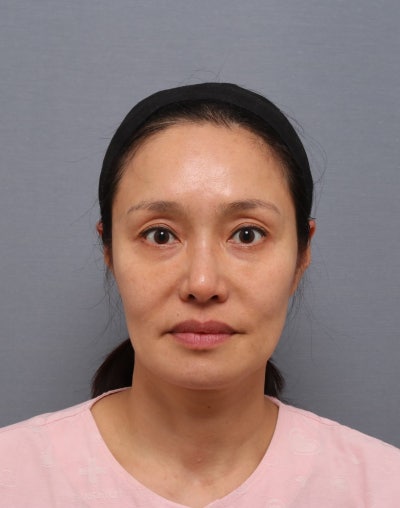
A virgin face undergoing a primary facelift differs significantly from a face that has already been operated on.
Following an initial surgery, scar tissue and internal adhesions develop beneath the skin, causing normal tissue planes to fuse or their boundaries to blur.
In particular, the extent of dissection in the previous surgery, how the SMAS layer was manipulated, and whether the deep plane was accessed substantially alter the tissue conditions encountered during revision.
Therefore, in revision surgery, determining "which plane to enter" is just as critical as deciding "how far to dissect."
Because multiple branches of the facial nerve course through the region, aggressively dissecting through dense adhesions presents significant risks.
Conversely, limiting the procedure to superficial adjustments merely out of concern over severe adhesions will yield inadequate results.
Ultimately, the cornerstone of revision facelift surgery lies in precisely identifying the altered anatomy and navigating into a safe surgical plane.
3. Revision does not mean simply pulling tighter
During revision consultations, patients occasionally ask:
"Since it sagged again after the first surgery, shouldn't we pull much tighter this time?"
However, I do not believe this is the right approach.
The purpose of a facelift is not to stretch the face as tightly as possible, but to reposition descended tissues back close to their natural anatomical positions.
Particularly in a face that has already undergone surgery, excessive skin tension can cause complications such as:
Widening of scars around the ear
Inferior traction deformities of the earlobe (pixie ear)
Distortion or elevation of the hairline
For this reason, in a revision facelift, it is imperative to minimize tension on the skin itself,
and instead achieve adequate mobilization and structural support from the deeper tissue layers.
In essence, the key to revision surgery is not "more tension," but "greater precision."
Closing Thoughts (Part 1)
A revision procedure is not merely repeating the initial surgery.
It is a far more complex and delicate process that requires accurately assessing altered anatomical structures, safely navigating adhesions and scar tissue, and selectively correcting the necessary areas.
In Part 2, I will discuss essential considerations in revision surgery, including scar management, the neck and jawline, and selecting customized surgical techniques for each individual patient.
https://youtu.be/DDfizTEyavM
Sincerely, Dr. Woo-hyun Tak, Tailor Plastic Surgery
Frequently Asked Questions
Is a revision facelift necessary if sagging recurs after the primary surgery?
Yes, revision surgery can be considered if natural aging progresses or if the primary result was unsatisfactory. Even after a facelift, facial tissues continue to age and lose elasticity over time; this reflects natural aging rather than surgical failure. Revision is also performed when the initial lift was inadequate, or when asymmetry or noticeable scarring remains.
Why is a revision facelift more challenging than the initial procedure?
The internal anatomy is altered by scar tissue and dense adhesions from the primary surgery. Because natural tissue plane boundaries become indistinct, dissection requires advanced precision to avoid facial nerve injury. Surgeons must accurately identify the correct surgical plane to achieve meaningful rejuvenation safely without aggressive, hazardous dissection.
Should the skin be pulled tighter during a revision facelift?
No, pulling the skin with excessive force is ill-advised. Excessive skin tension can widen scars around the ears, cause downward traction on the earlobes (pixie ear), and distort the hairline. The objective of revision surgery is to minimize skin tension while securing adequate support and repositioning within the deeper structural layers.
What is the most crucial consideration when deciding on a revision facelift?
The most important step is accurately analyzing the shortcomings of the previous surgery and identifying a safe surgical plane. The surgeon must understand the extent of prior dissection and how the SMAS layer was treated, formulating an individualized surgical plan that establishes deep structural support tailored to the altered anatomy.