2026-09-10
Forehead Lift Dissection Range: How Far Should It Go? Muscles, Nerves, and Fixation Explained | Tailor Plastic Surgery
Understand the vital dissection range, muscle manipulation, and dual-plane fixation techniques in endoscopic forehead lifts by Tailor Plastic Surgery.
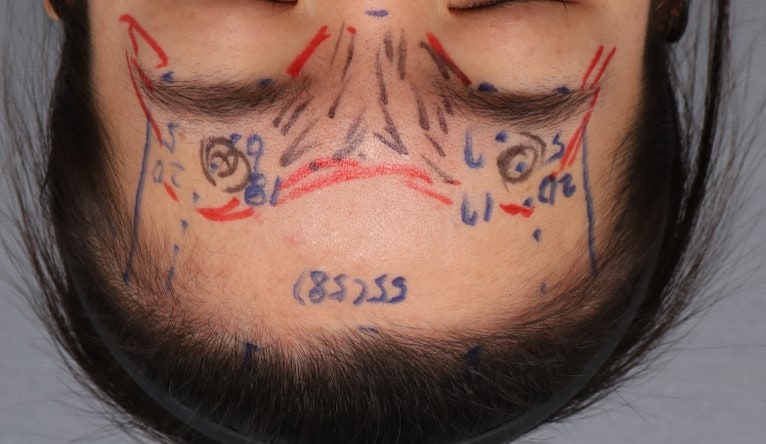
Hello, this is Dr. Woo-hyun Tak from Tailor Plastic Surgery.
Many patients considering a forehead lift often ask, "I hear dissection is the most important part, but exactly from where to where should it be done?"
Even among those who have already undergone surgery, many feel frustrated because there is no way to confirm externally whether the dissection was performed properly. At Tailor Plastic Surgery, we record the entire endoscopic dissection process so that patients can review it directly after surgery. Many find great peace of mind seeing the internal surgical procedure on video.
Today, I will explain the key essentials of a forehead lift in order: the extent of dissection, the muscles involved, fixation methods, and common misconceptions about nerve damage.
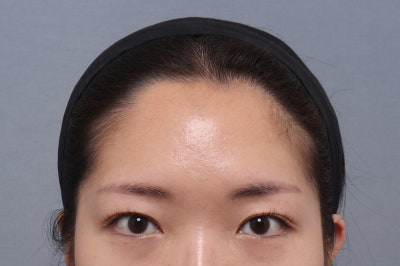
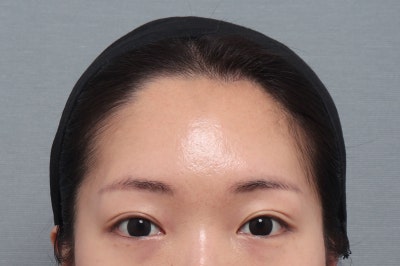
How Far Should Forehead Lift Dissection Go?
To understand why the extent of dissection is critical, you must first grasp the basic mechanism of a forehead lift.
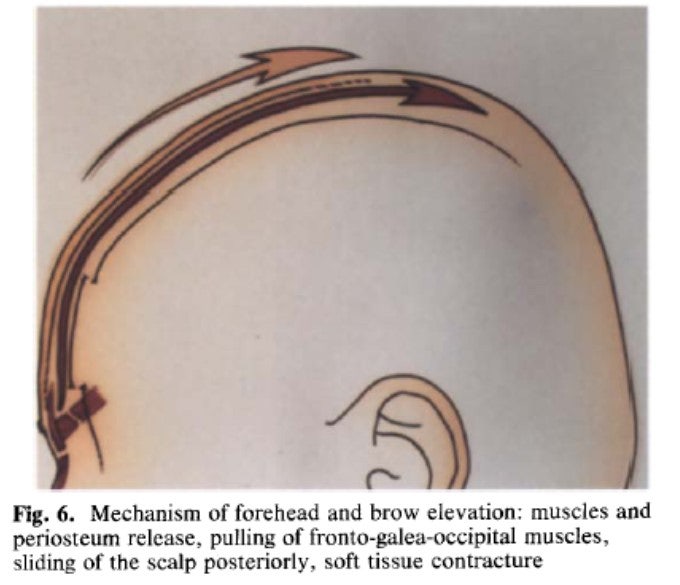
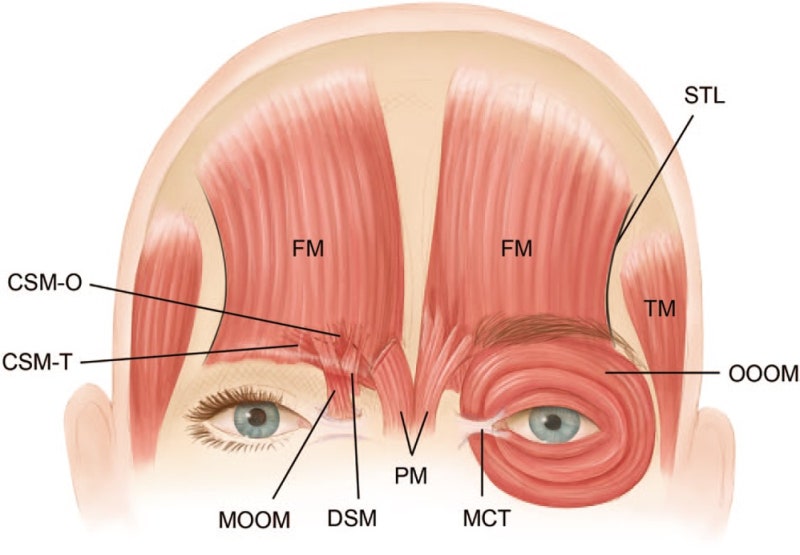
A forehead lift elevates the brows by weakening the corrugator supercilii muscle (CSM) and depressor supercilii muscle (DSM), both of which pull the eyebrows downward. Because the muscles and fascia are interconnected from the back of the head all the way to the forehead, this entire layer must naturally reposition backward for long-lasting surgical results.
If the scalp folds or bunches in any single area, this repositioning effect is compromised. Therefore, the standard rule for posterior dissection is to extend all the way to the vertex (crown of the head).
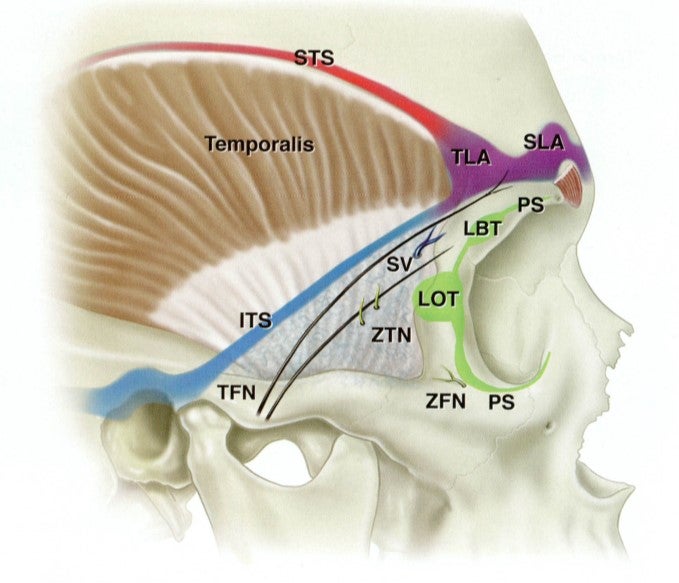
Toward the front, near the eyebrows, dissection is performed according to the condition of the retaining ligaments, as illustrated below:
Red retaining ligament: The first area encountered; released almost completely.
Purple retaining ligament: Likewise released completely.
Blue retaining ligament: Released by about half.
Green retaining ligament: Varies depending on your aesthetic goal — dissected down below the eye if you want to lift the outer corners of the eyes, or only halfway if you do not want the outer corners elevated.
Muscles Requiring Dissection — From Corrugator to Orbicularis Oculi
Here is an overview of the key muscles addressed during a forehead lift.
**Corrugator Supercilii Muscle (CSM) and Depressor Supercilii Muscle (DSM)** are the most powerful muscles pulling the eyebrows downward. Without thoroughly releasing these two muscles, elevating the brows itself becomes difficult.
After incising the corrugator muscle, both cut edges are treated with electrocautery to prevent regeneration. In cases where the corrugator muscle has significant bulk and deep frown lines appear even when relaxed, the muscle is almost completely excised endoscopically, accompanied by fat grafting in the vacated space. Without fat grafting, the excision area often becomes uneven or develops irregular adhesions, making fat grafting essential when resecting the corrugator muscle.
**Procerus Muscle (PM)** creates horizontal wrinkles across the bridge of the nose and can hinder brow elevation, so it is frequently incised.
**Medial Orbicularis Oculi Muscle (MOOM)** is addressed only when it is excessively strong; it is often unnecessary to touch in standard cases.
Fixation Sites and the Dual-Plane Technique — How Is It Secured After Dissection?
Where and how the scalp is anchored after dissection is equally crucial.
I apply a 2-row bone tunneling fixation method to distribute tension away from the incision lines. This prevents scars from stretching and helps minimize the risk of hematoma formation.
Regarding the dissection plane, I utilize my proprietary Dual-Plane (Plane-Shifting) forehead lift technique. To explain it with an easy analogy:
Imagine the supraorbital nerve as a 'person.'
Subperiosteal dissection: Lying on a hard, freezing floor with only your neck pulled taut.
Plane-shifting dissection: Resting comfortably and fully relaxed on a soft, warm duvet.
If subperiosteal dissection continues uniformly down to the eyebrows, the nerve is subjected to strong, localized pulling tension. In contrast, the Plane-Shifting approach shifts the dissection plane at a specific point, leaving a protective cushion of tissue beneath the nerve to disperse mechanical tension.
Puppy Eyes vs. Cat Eyes — The Dissection Scope Changes
The range and approach of dissection differ depending on your desired eye shape.
Puppy Eyes (elevating the medial/front brow): The corrugator, depressor supercilii, and procerus muscles are incised to alter the brow angle, while the posterior green retaining ligament is left untouched. As the inner brow ascends, the eye expression becomes gentle and soft.
Cat Eyes (elevating the lateral/tail brow): A portion of the procerus is preserved, and the posterior retaining ligaments are released as extensively as possible. As the outer brow and corners lift, the impression becomes sleek, sharp, and defined.
Because outcomes vary depending on redundant skin and tissue characteristics, a thorough preoperative consultation is essential.


Will Dissection Sever Nerves? — The Most Common Misconception
This is both the most frequent question and the most widespread misunderstanding.
There are no major blood vessels or nerves in the dissection plane toward the vertex. Because this layer consists solely of loose areolar tissue, dissecting this region does not trigger nerve symptoms or increase bleeding risk.
The real cause of post-lift sensory changes lies elsewhere: the sensory nerves extending near the brows experience temporary traction or compression during surgery. Mitigating this pressure and tension is precisely the primary objective of my Dual-Plane technique.
The sensory recovery timeline varies across individuals, but typically progresses as follows:
Recovery Milestone | Recovery Rate |
2–3 months post-op | Approx. 90% |
6 months post-op | 90% of the remaining 10% recovers further |
In most patients, sensation returns close to normal within 6 months.
Closing Thoughts
In forehead lift surgery, extensive dissection is not inherently superior; the true key is accurately selecting the appropriate range and anatomical plane tailored to your specific goals.
Because the dissection boundaries and muscle management vary based on your desired eye shape and tissue laxity, personalized consultation beforehand is vital.
We have also prepared a video detailing today's topic for those who wish to learn more.
https://youtu.be/ATgjOOFukZQ
Thank you. This has been Board-Certified Plastic Surgeon Dr. Woo-hyun Tak.
Frequently Asked Questions
How far back does posterior dissection go in a forehead lift?
As a rule, dissection extends to the crown of the head (vertex). Muscles and fascia are interconnected from the occiput to the forehead, so the scalp must smoothly redistribute backward without folding or bunching to ensure lasting lift results.
Is fat grafting necessary when resecting the corrugator muscle during a forehead lift?
Yes, fat grafting is essential when removing the corrugator muscle. If significant muscle tissue is resected to eliminate severe frown lines without concurrent fat grafting, contour depressions or undesirable tissue adhesions can occur.
Does dissecting during a forehead lift sever the nerves?
No, dissecting toward the vertex does not sever nerves. That specific plane contains only loose areolar tissue without major vessels or nerves. Temporary numbness after surgery typically arises from mild stretching of sensory nerves around the brow.
When does normal nerve sensation return after a forehead lift?
Most patients regain near-normal sensation within 6 months. Recovery varies individually, but roughly 90% returns by 2 to 3 months post-op, with 90% of the residual sensation recovering further by the 6-month mark.
How does dissection range vary depending on the desired eye shape?
Dissection of retaining ligaments and muscles is tailored to your target look. For gentle 'puppy eyes,' the lateral green retaining ligament is preserved, whereas for a sharp, lifted 'cat eyes' contour, the lateral retaining ligaments are extensively released.