2026-11-25
Facial Lift Revision Surgery: Why Scars, Ear Deformity, and Neck Sagging Must Be Checked Together (Part 2) | Tailor Plastic Surgery
Dr. Tak Woo-hyun explains why facial lift revision surgery must consider old scars, pixie ear deformity, and neck and jawline changes along with current tissue condition.
Hello, I am Dr. Tak Woo-hyun of Tailor Plastic Surgery.
In my previous article, I explained what to consider when evaluating facial lift revision surgery.
In this article, I will continue from there and explain why scars left from the previous surgery, changes around the ear, and the neck and jawline should all be considered together.
Even for the same facial lift revision surgery, the necessary corrections differ depending on the details of the previous operation and the current condition of the tissues.
I will walk you through what we check and how that information guides the direction of the surgery.
4. Scars from the previous surgery must also be examined
One of the things I consider most important in facial lift revision surgery is the condition of the existing scars.
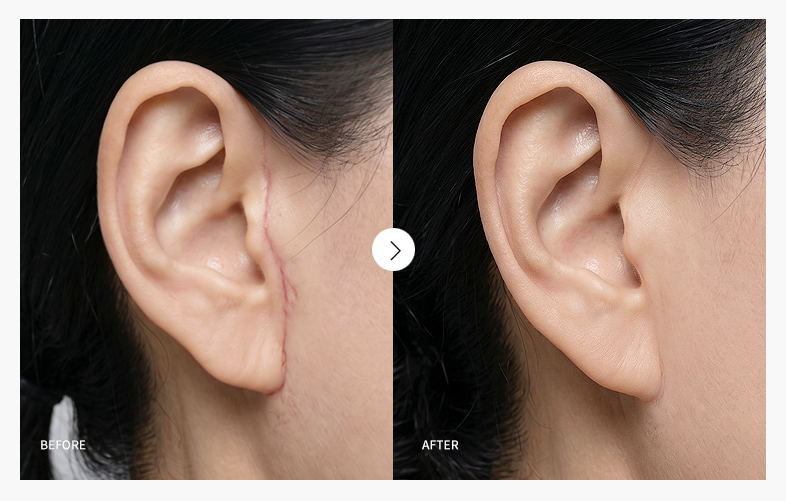
After the first surgery, the scars in front of or behind the ear may have widened or extended beyond the natural border of the ear, making them noticeable.
When excessive tension has been placed on the skin, the earlobe may also appear pulled downward.
This is called a pixie ear deformity.
In such cases, we need to evaluate not only facial sagging but also the position of the scar and the shape of the earlobe.
We consider the position of the existing scar together with the shape of the area around the ear.
Image source: Tailor Plastic Surgery official website, Facial Lift Revision Surgery
When planning revision surgery, we consider how much of the existing scar can be improved and where the incisions can be placed,
as well as how to reduce the tension pulling on the area around the ear.
Even if the sagging tissue is lifted again, residual excessive tension on the skin can affect the scar and the shape of the ear.
However, not every scar can be improved to the same degree.
The extent of correction depends on the location of the previous incision, the width of the scar, the amount of remaining skin, and each patient's skin characteristics.
For this reason, during consultation, it is necessary to directly examine the scars in front of and behind the ear as well as the condition of the surrounding skin.
5. The neck and jawline must be evaluated together with the face
“It feels like my face has sagged again.”
This is a common concern I hear during revision consultations. However, when we examine the patient, the changes under the chin and in the neck are sometimes more pronounced than sagging of the cheeks.
Several structures contribute to a blurred jawline.
Fat may accumulate under the chin, or the platysma, a muscle in the neck, may have become lax.
In some cases, the condition of deeper tissues also plays a role.
Because the causes differ, we must first determine whether simply pulling the facial skin is enough.
We look at the face and neck as connected areas and determine the extent of correction needed.
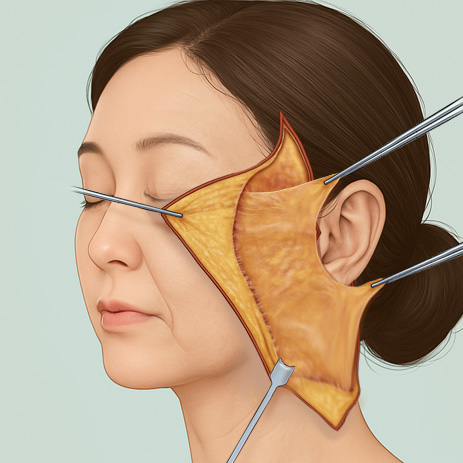
After pulling the SMAS to confirm that the midface and lower face are effectively improved, SMAS suturing is performed.
Image source: Tailor Plastic Surgery official website, Tailored facial and neck lift
I view the face and neck as one continuous structure and examine which area's changes are affecting the current contour.
Even if facial sagging is corrected, if significant issues remain under the chin and in the neck, the patient's dissatisfaction may not be fully resolved.
In revision surgery in particular, it is important to confirm whether the neck was also corrected during the first operation and, if so, what method and extent were used.
Based on this, we distinguish whether the remaining problem is skin laxity, platysma laxity, or the effect of fat or deeper structures, and then decide the extent of correction needed.
6. The same technique cannot be applied to every revision surgery
Even for the same facial lift revision surgery, the surgical conditions differ from patient to patient.
Tissue condition can vary depending on how much time has passed since the first surgery, the technique used, and how far the dissection extended.
We also need to check the current condition of the skin and SMAS, and whether the patient has had neck surgery as well.
For some patients, limited correction of sagging or scarring in certain areas may be sufficient. For others, the condition of the deeper tissue layers needs to be reassessed,
and dissection of the necessary area may be required to reposition the tissues.
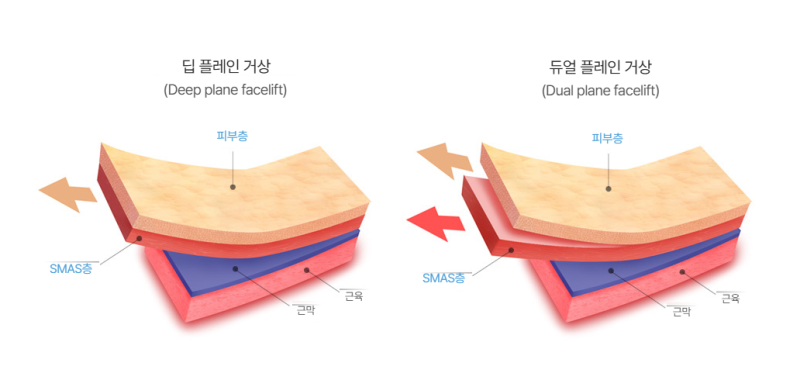
Comparison diagram of deep plane and dual plane surgical layers. The actual surgical approach is determined by taking into account the details of the previous surgery and the current condition of the tissues.
Image source: Tailor Plastic Surgery official website, Facial Lift Revision Surgery
If there is volume loss in certain areas, fat grafting may be considered. If the position of fat or neck sagging is the concern, correction of those areas may also be planned together. However, these steps are not necessary for every patient.
First, we need to determine what is causing the sagging in the current face, which structures have changed as a result of the previous surgery, and which tissues should be preserved and which areas need to be readjusted.
Based on this process, I believe that determining the appropriate scope and method of surgery for each patient is the starting point of revision surgery.
7. In revision surgery, accurately determining the necessary layers and extent is essential
In facial lift revision surgery, adhesions and scar tissue created by the previous operation must be taken into account.
Because tissue positions and conditions may have changed, it is important to proceed with surgery while carefully identifying the current anatomy.
Simply dissecting more extensively or pulling the tissue more tightly does not resolve these issues.
We must determine which layer the tissue can be separated from, how far the tissue must be released to move the sagging tissue, and in which direction it should be repositioned.
At the same time, it is important to make sure no excessive tension remains on the skin.
This is because the scar width and ear deformity discussed earlier are also linked to how the tissue is moved and fixed in place.
In revision surgery, I believe the key principles are to accurately identify the necessary layers, dissect only as much as needed to allow the tissue to move, and then reposition it in the appropriate place.
Final Thoughts
If sagging has returned after facial lift surgery or you are dissatisfied with the results, it is important to first identify the cause.
The approach differs depending on whether the change developed over time, whether it is a problem that remained after the first surgery, or whether scars or ear deformities are also present.
Therefore, during consultation, it is important to review the details of the previous surgery and the current condition of the tissues together, and to thoroughly discuss what can be corrected as well as the limitations.
Understanding the structural changes caused by the previous surgery and choosing the correction that is needed now: this is what I consider most important in facial lift revision surgery.
Thank you. This is Dr. Tak Woo-hyun, a board-certified plastic surgeon.
※ Surgical methods and outcomes may vary depending on each individual's anatomical characteristics, skin condition, degree of aging, and past surgical history.
https://youtu.be/mDiQ4T3OMEU?si=ZGZ0b1tElzR0gNMt
Frequently Asked Questions
Do you also examine existing scars during facial lift revision surgery?
Yes. The condition of existing scars is one of the key factors considered in revision surgery. After the first operation, scars in front of or behind the ear may widen or extend beyond the natural border of the ear, making them noticeable, so we consider the scar position together with the shape of the area around the ear.
What is a pixie ear deformity?
A pixie ear deformity refers to a condition in which the earlobe appears pulled downward. It can occur when excessive tension has been placed on the skin. In such cases, we examine not only facial sagging but also the position of the scar and the shape of the earlobe.
Are the neck and jawline also corrected during revision surgery?
The neck and jawline are evaluated together with the face, and the extent of correction needed is determined accordingly. Because the causes differ, such as submental fat, platysma laxity, or the influence of deeper tissues, we first determine whether simply pulling the facial skin is enough.
Is the revision technique the same for every patient?
No. Even for the same facial lift revision surgery, the same technique cannot be applied to every patient. Depending on the timing and technique of the first surgery, the extent of dissection, the condition of the skin and SMAS, and whether neck surgery is performed at the same time, the approach may vary, from limited correction of certain areas to repositioning of deeper layers.
What should be checked during a revision consultation?
It is important to review the details of the previous surgery alongside the current condition of the tissues. Key points include whether the neck was corrected during the first operation and, if so, the method and extent used; the scars in front of and behind the ear and the condition of the surrounding skin; and a thorough discussion of what can be corrected and its limitations.